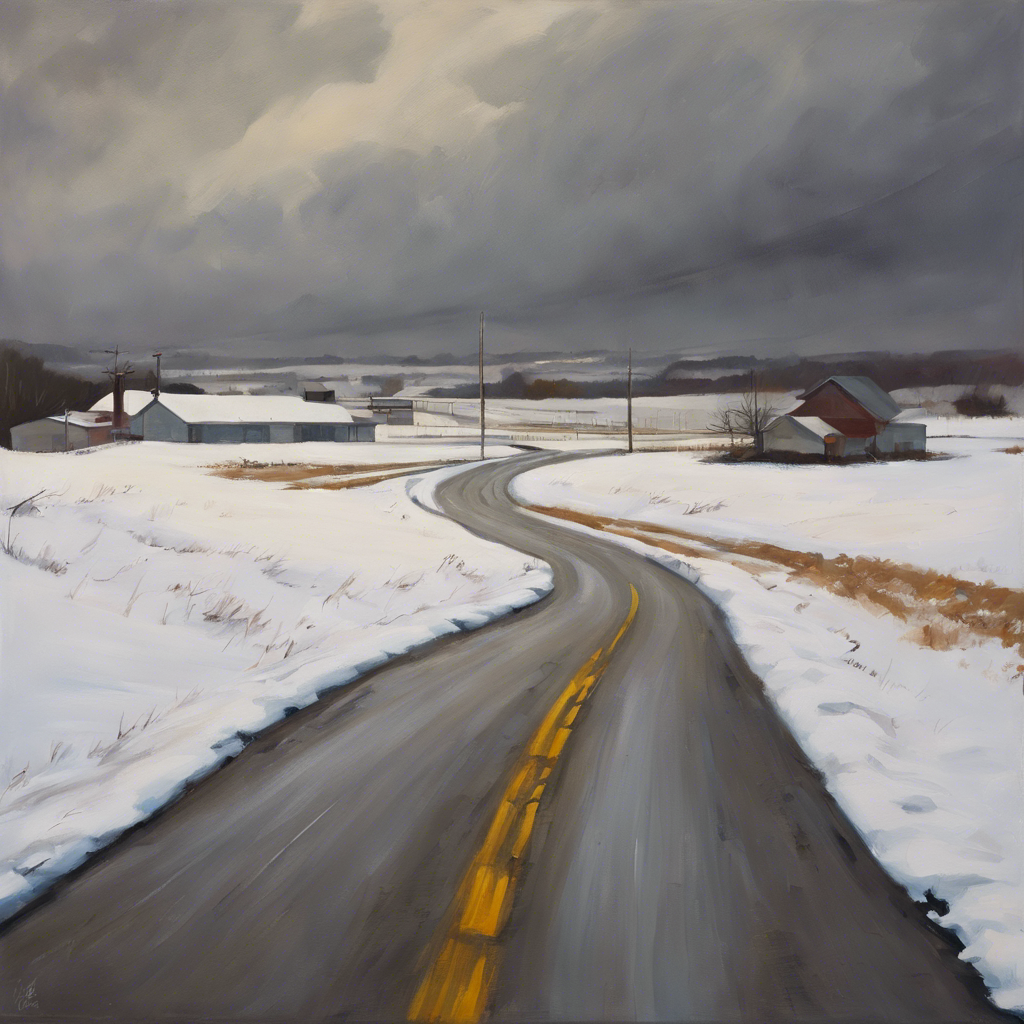
For Garry Kravit
The sky dark, grizzly, needles of icy air
the afternoon we dropped the dogs at Kim’s
kennel she runs out of her home, I knew
something was coming, overnight while we
slept the blizzard happened. We packed
suitcases in the CRV, in the dark crept onto
the winding road to the rural airport. Ten
miles per hour, maybe fifteen, the road
that slick, the parking lot, plowed enough
to park, was all snowbanks. We lugged
the suitcases in, checked them and finally
cleared security. The little room all light,
outside all dark, then I met George Parks,
his dad TJ I knew. George lived in Houston,
our destination, if; the weather, as it was,
that was a big if. So we waited. Stood
looking out at the dark, snow still falling.
Then the flight crew came in. I found
myself sitting beside one young man who
wore a black blazer, gold wings on a lapel,
like the other crew wore. I’ll call him Bobby,
I don’t recall his name. We got to talking
so we were on a first name basis as we
waited and waited, the weather outside.
Bobby, no older than George, lived in
California. Before long I was saying, ‘Bob,
if you keep things open with Jennifer you
might still go out with Cathy,’ or maybe
her name was Sheila. ‘If you like Sheila
continue to see her, you and Jennifer
can remain friends.’ It wasn’t that easy.
Bobby’s love life tangled, he was perplexed
and had come to me, a stranger he found
himself seated beside in a small airport.
I was flattered, though I didn’t think so
then, too busy listening. Giving advice
an older man gives a younger to make
the young man’s life, the path in Bobby’s
romantic woods, a bit less foreboding
to walk in the dark of what I’ll call reality.
I got into it to the point we both knew,
with no easy answers, we go forward.
Finally a voice over a speaker, the black
uniforms went out and boarded the plane,
a thirty or forty seater, not too small, but
no jumbo jet. And we waited, and finally
the engines started, and Bob the one
who started them, the pilot in the cockpit
at the controls, the decision to leave
the ground, his alone. Cleared for take off
the plane, after the wing deicing, sped
down the runway and up. Out the window
snow in darkness. We rose higher and
higher, headed south. Soon light shined
into the cabin. An attendant with the cart
on wheels came by, I asked for coffee black.
Hunting Rifle
Faye lived two floors above me.
She brought her past along for the ride
the night, across a table
in a restaurant booth she said,
‘My father, terminal
with cancer, shot and killed my brother
and his best friend in the garage
of our suburban home.’
Back in our three-story building,
a desk drawer opened, she took out news
clippings of the double homicide.
She was crying when I left her.
Navy Blue Impala
You’re 16, 17, 18, doing something you
weren’t supposed to do—idling away
an hour in a psychedelic room blowing
marijuana into a cat’s face,
or with a screwdriver in a parking lot
prying an emblem off a Cadillac’s hood,
or slipping a glossy Nugget or Playboy
from a shelf into your windbreaker—Tony
was the kind of guy who’d walk up
and say, What if your mother saw you
doing that. In his small brown eyes
mirth designed to evoke guilt. So while
you were rebelling in the drug-addled 60s
Tony, nose to the grindstone, was the boy,
the young man your parents liked.
I guess it was fitting his two-year stint
in the army he was an MP in Okinawa.
I didn’t see him much after that but a lot
before. Not doing anything wrong
but close by. Like a conscience. Kinky
hair, small brown eyes, ski-jump nose,
slightly ruddy complexion, carriage
a slight slouch, as he’d walk up to us.
What if your mother…Oh, go away, Tony!
So I as others was startled to learn
he’d dropped acid in a Wildwood motel
room one night, maybe did something
crazy like knock over a lamp. Couldn’t
have been too crazy, he wasn’t led off
the premises in cuffs, in a patrol car.
He drove a sharp ‘66 navy blue Impala.
It wasn’t given to him. An electrician’s
apprentice, then an electrician, years
later he helped a friend’s son get into
the union, as, years before, he was helped.
By nature grouchy, which complemented
the slight slouch, one day he said, I pay
good money to have my shirts starched.
A complaint, Tony throws his hands
into the air, as if to say, What can you do!
One day he came home and never walked
back out his door. What if your mother…
In pressed pants and a high roll collar
shirt, on his face the slight scowl ready
to smile, he gets into his Impala.
ABOUT THE ARTIST
Peter Mladinic’s most recent book of poems, Voices from the Past, is available from Better Than Starbucks Publications. An animal rights advocate, he lives in Hobbs, New Mexico, United States.
Image created on DreamStudio
YOU MAY ALSO LIKE…

Fish in love by Mykyta Ryzhykh

Found Poetry: ‘Poet Interruptus’ by Uncle Toby

The Old Fisherman by James Callan

Solid Flesh Would Melt and 1 more by Damon Hubbs

Journey After the Show and The Slaughtering Cause by Ben Nardolilli

Leave a Reply