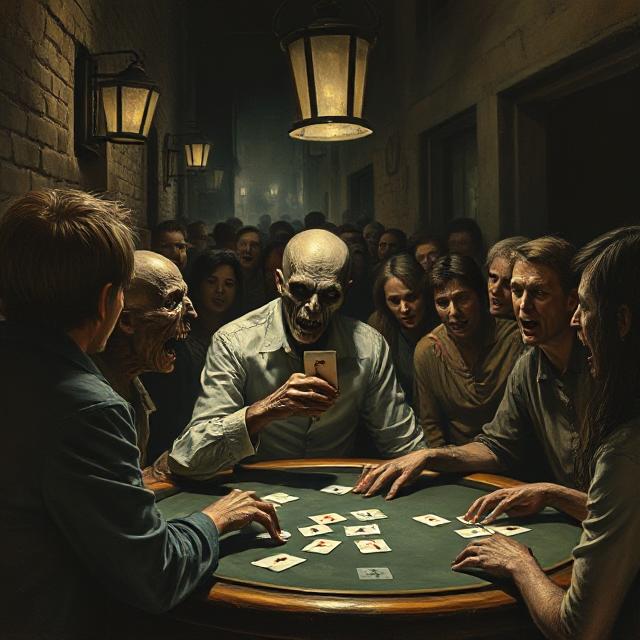
— The wings of fate I hear aflutter… said the crow-faced man sitting across the board from young Tupelow, who stared in mute concentration at the result of his last decision.
Just three photographs remained, from ten initially laid out in sharp diamond shape, acute angles pointing like arrows at the two players: the Banker, safe in his established position, constrained only to continue squaring off against the longings of younger men until his own days expired; and the Candidate, in this instance my dear friend Tupelow, gambling life and limb in the vacuous hope to attain, through this only possible instrument, a happiness beyond measure, surpassing any reasonable man’s imagination, yet which he had determined not to pursue his existence without.
The crowd, composed of inveterate amateurs and disinterested parties—as those whose destiny depended on the game were all, save one, already held in public execution chambers scattered around the city—now stood in hushed fascination. Rarely, only twice in current memory, had a player reached this ultimate stage where one question subsists, and one decision, before ever-elusive victory. Needless to say, neither past Candidate had prevailed, and the piles of sparkling white bones, picked clean by both winged and furred scavengers, had only grown outside the walls as consequence of their doomed endeavors.
One had wanted unlimited wealth: a common ambition, albeit usually kept to a remoter scope than had this young dreamer dared; the other had coveted in marriage our Supreme CEO’s daughter: an equally frequent desire, as this was the most beautiful, albeit entirely surgically elaborated, of woman in our midst, capable of inspiring madness in the most rigorous bachelors and as such, allowed to marry only the winner of this traditional gauntlet—which means that each had, so far, died a splendid mechanical maid. But young Tupelow had expressed a most singular yearning, causing much curiosity and admiration among the cognoscenti, if no further confidence that he would succeed. The gods, as we know, do not reward purity of intentions—supposing they reward anything.
Tupelow, as all Candidates must, had committed to his gamble not only his own life, but that of his closest eight relatives: his parents, a younger brother, two grandparents, one uncle, one aunt, and one first cousin (the oldest son of his paternal uncle, as dictated by the masculinist hierarchy which prevailed once more since the Great Leap Upward of 2025). These ‘sidebets’ did not have to provide consent; the Candidate made his proposition alone. But then he must, which stopped many interested younglings either before or just after communicating their intent to the Gaming Commission, spend the next 24 hours in complete isolation with those whose life he had deemed acceptable wager against his ambitions. Much strength, physical or of persuasion, was assumed necessary to prevail in this first crucible, which no one had ever been allowed to observe or otherwise record. Only when the candidate, upon the defined time expiring, was no more to be found to represent his claim were the relatives allowed to return to their previous stations; and none, from this vantage point, had ever volunteered a narration of the events which had them theretofore led.
Of the nine persons thus selected for the game, photographs were generated, portraying them 20 years onward in the event of the Candidate’s victory. The tenth picture was, spawned by Artificial Intelligence, a composite of the previous nine, seemingly as truthful but, for a reason which it was the object of the player’s effort to unveil, inherently impossible for the future to produce.
The game was simple: the Candidate could ask three questions, formulated so as to elicit only a ‘yes’ or ‘no’ response from the Banker ; then, after each, turn over a number of photographs of his choosing. If only the AI-generated photograph remained visible, he won; otherwise, he lost. No time limit was set to the proceedings.
Often, the first photographs were easy enough to eliminate: an aged relative could usually be counted on, 20 years later, to rest embalmed in a sarcophagus. Some conclusions could be drawn from the appearance and attire of the subjects, especially when the candidate’s aspirations included the gain of great wealth, presumably intended to be shared among the same relatives, in quantities susceptible to appear on their person; and sometimes from the presence of children. Thus, it was only in part a game of chance; much intelligence and deductive powers also came to bear, or seemed that they should, on a player’s few but decisive moves.
Yet dear Tupelow had given himself none of these advantages of material simplicity; even his grandparents were young. As really only a madman would (but the few of us who knew him understood that he was far from insane, only passionate to extreme exclusivity about the object of his ardor), he had gambled it all seeking to be allowed to spend his life writing poetry.
No teaching positions, no jobs of convenience, no compromises on his mind and time: he wanted all and every moment devoted to the art of encasing spirit into the music of words. And, in what would have been abhorrent arrogance without the infinite fineness of the poetry that he had, despite his young age, already produced, he claimed that what his work would provide humanity as a whole, over time, amply justified his wager of self and family.
And now, there he sat. He sat for three hours, contemplating photographs which, to the crowd, bore no remarkable difference. In each, a middle-aged man, of similar features to his parallel companions, and dressed in rather nondescript attire, was engaging in a trivial, daily task: one was shaking invisible objects while wearing a Virtual Reality mask; another was skinning phosphorescent jellyfish for his dinner; and the third was gathering sunrays into a smoking flask, evidently preparing for a nap.
Tupelow sat, contemplating for three full hours his last move. Then he surprised us all.
— I think I’ll pass… he finally, raspily said, then repeated: Yes, I’ll pass.
Stupefaction had frankly never reached such heights in this most emotion-inducing of rituals. A pass, at this last stage of the game, signified leaving the whole outcome not only in the hands of polymorphic fate, but also, partially, up to the whim of this day’s Banker, whose actual, bony fingers would, at the time and in the order of his choosing, turn over two photographs and let the remainder be revealed on the spot for what it was. Real or fake? Carrier of life or death?
Himself the Banker seemed stunned. Well trained he was in the art of splitting a question’s potential meaning in all manners which could justify a given answer ; but to evaluate pictures, or decide not to and entrust the result to pure fortuity, were not acts which he had ever supposed would be required of him.
Thus the Banker thought long and hard, and during that time, we all saw with growing amazement young Tupelow emerge free, entirely free at last, from the cocoon of fear which ensconces us all, and compose, counting syllables on his fingers, silently singing on his barely quivering lips, and choosing in his mind each turn of phrase with evident satisfaction, a poem.
About the artist

Antoine Bargel does not currently have a website nor social networking accounts. He has contributed to The Gorko Gazette before. His personal website is https://antoine.bargel.eu
YOU MAY ALSO LIKE…

Hi ♥ Lorenzo! and 3 more by John Martino

Naughty Chalks by Theodore Wallbanger

#17

THAT’S WHAT IT FEELS LIKE by u.v. ray

Le Penseur by Doug Hawley and Bill Tope

leopard print and 1 more by Nathaniel Sverlow
Image created on deepai
Leave a Reply