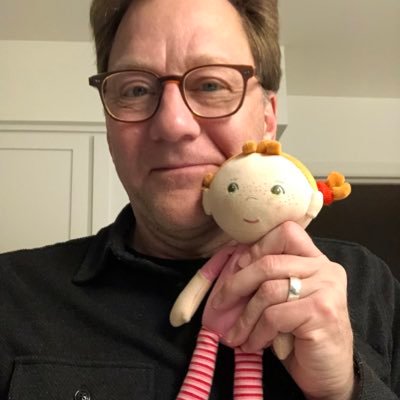
robert fromberg
Robert Fromberg’s latest book is Gee, That Was Fun: Unhappy Accidents and Planned Damage, October 14-20, 1983. He also wrote the memoir How to Walk with Steve (Latah Books, 2021), which won the Next Generation Indie Book Award for memoir, and the essay collection Friends and Fiends, Pulp Stars and Pop Stars (Alien Buddha Press, 2022), which won no awards.
IG: @robfromberg
TGG: Who are you? Talk to us, we are your fans.
RF: Thank you for your fandom! I am the child of a father who was an unheard-of type, a light-hearted abstract expressionist painter and experimental filmmaker, and a mother who was a much more common type, an angst-ridden figurative expressionist painter. Speaking as an apple, from that tree I fell five feet, eight inches, and sixty-plus years later from my tree sprouts light-hearted, readable, structurally experimental prose, with shall we say notes of angst. I do that in the lovely city of Madison, Wisconsin.
TGG: Tell us about your new book, Gee, That Was Fun. What is it, where did the concept come from, did you give birth to it whole cloth, or was there an epiphany or process through which the book took final form?
RF: For about six months, I was out of commission with long COVID—brain fog, headaches, exhaustion. I couldn’t read or write. As I started to come out of this state, I read mostly news headlines, including those from my hometown of Peoria, Illinois. One hometown headline touted the 40th anniversary of one of the nation’s largest botulism outbreaks, which was traced to patty melt sandwiches served at a restaurant in Peoria’s Northwoods Mall. I read everything I could about the outbreak, perhaps because I had just had my own out-of-nowhere health problem. I was fascinated by the victims, how through no fault of their own, their lives were upended, many in the hospital on respirators for months, and most experiencing health problems for the rest of their lives.
I wondered what other odd, accidental, or purposeful damage might have been happening elsewhere during that week of October 1983, and the first bit of research showed me that on the day people were eating those first botulism-infected patty melts in Peoria, a woman in New York City had a window air conditioner fall on her head.
Further newspaper research yielded a swarm of accidents, cruelty, and absurdity. I limited my research to Peoria, New York City, and Washington, DC. Some ended up being quite well known; others were almost immediately forgotten. The news reports were relentlessly retrospective. Because my own experience of health mayhem was the perpetual present with an unknown future, I recast these events into an hour-by-hour, sometimes minute-by-minute account from the points of view, mostly imagined, of those affected.
TGG: Gee, That Was Fun is extremely ambitious in its range of proper names and personalities, all that you could squeeze out of or into one week in 1983. How did you decide which characters to include/exclude? Are any of them characters you just invented?
RF: The sieve for people and events was intuitive—whichever seemed to strike the right chord of absurdity, erring on the side of inclusivity. All the public figures and botulism sufferers are real, although their perceptions are fictionalized. In some cases, I made up characters witnessing the more overt events, such as the poor woman trying to deal with the new phone system at the Department of Health and Human Services and the boy delivering newspapers. The cook responsible for the botulism, who later becomes one of Peoria’s first punk musicians, is also made up.
TGG: What has been the initial response to Gee, That Was Fun from readers? I personally was immediately sucked in by the damn-the-torpedoes, in medias res narration, but slightly disoriented by not knowing whether it was fact or fiction.
RF: The response has been delight (so they say) mixed with confusion. The latter is understandable because I threw the reader into the deep end of the pool, although I like to think that I lay out the restrictions and form clearly enough that after a dozen or two pages the structure is clear, even if the veracity of the people and their experiences takes longer to infer. There are so many novels out there. They are all so good. I like reading all of them. Nobody needs me to add another novel to those. So I write something else—understandable, I hope, out of sync with the expectations set by most writing, but tightly in sync with a logic true to my sense of the world.
TGG: I particularly enjoyed the Norma and Mel Texas Education Research Analysts subplot, with its cloying fundraiser events and all motivations attributed to THE LORD. There are also senators, presidents, CIA agents, sous chefs, soccer moms, and kids messing around on their bikes. Which were your favorite parts to write?
RF: I adored writing the part about Mel remembering his Christian-movies-only drive-in theater. I was shocked that I was writing something sympathetic about a person with such a vile mission. I also loved the boy folding his newspapers with such precision. And, for sure, the nonsense dialogue from Jesse Helms pulled straight from the Federal Record was a blast to copy and paste, when I wasn’t screaming or weeping.
TGG: I deduce that you published Gee, That Was Fun with the publishing cooperative Trunk of My Car (trunkofmycar.org). How was your experience with that group and using their platform? In a nutshell, how did it work, and would you recommend it for other writers?
RF: I’ve published books with traditional publishers. But given my age and health, there was no way I was going to spend two years of my life hacking through the thicket of submitting and waiting and editing to some else’s taste and waiting. Trunk of My Car is just getting its sea legs (or is it land legs?), but the cooperative model is right for me: more control, a community for support, and a speedier timeline.
TGG: What are you working on now, and/or what would you like to publish in the future?
RF: I’m writing a novel called The Serial Stowaway based on the real-life Marilyn Hartman, a 60ish-year-old woman who has flown something like 40 times without a ticket. I’m enjoying imagining not only the details of her sneaking around, but the many characters she must have sat next to on all those flights.
READ AN EXCERPT FROM GEE, THAT WAS FUN RIGHT HERE ON THE GORKO!
GET A COPY OF THE WHOLE DARN THING HERE.
YOU MAY ALSO LIKE…

THIS WEEK’S HOROSCOPE by Ben Macnair

No. 81

Leave a Reply