plot hole exit
by Hugh Blanton
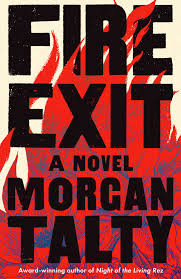
Fire Exit is the debut novel from Morgan Talty. Our main character Charles Lamosway grew up on a Penobscot reservation in Maine, but at age eighteen was removed because he did not meet the blood quantum rules required for residency. His stepfather, Frederick, helped build a house for Charles off the reservation just across the Penobscot River. And this is where our story opens up—decades after the house was built Charles is sitting on his porch looking across the river at the reservation where his daughter is living, as he’s been doing for years. However, she doesn’t know Charles is her father. She does not know Charles at all.
Much of the story revolves around Charles’s off-reservation home and is also a plot hole so large you could drive a Kenworth through it. According to the Penobscot Nation Tribal Census Maintenance Procedure:
‘Adopted individuals who have been enrolled into the Nation shall enjoy all the rights and privileges of tribal membership except that no such member shall be eligible to hold the office of Chief, Vice-Chief, Representative of the Tribe, serve on the Tribal Census Committee, act as a sponsor, or participate in the Tribal Trust Fund if the individual is adopted after December 1, 1980. These restrictions shall not apply to any individual entitled to enrollment through birth (Sec. 1.6.3) or birthright (Sec. 1.7) as determined by the Census Committee but was denied membership or not accorded full membership rights through the application of Section 6.0 (January 1, 1983, Closed Census) effective the date of enactment by the General Meeting (December 11, 1999).’
If Frederick had simply adopted his stepson he wouldn’t have had to leave the reservation.
Talty’s prose is overwrought to the point of slowing the story; on the first page of the book the narrator tells us twice that he’s drinking coffee. The narrator also smokes. A lot. ‘I smoked. When I finished, I smoked another.’ ‘I did not know what to do but wait. So that’s what I did. I waited and smoked and waited and smoked.’ To make it even more overwrought he tells us what he’s not doing; as in when he is not smoking, not making breakfast, or unable to read the cursive font on a clerk’s nametag. He also includes untranslated Penobscot song lyrics (written with English alphabet characters and more dashes than an Emily Dickinson poem).
Charles’s stepfather was killed in a hunting accident and Charles is racked with guilt over it. His mother had always insisted that her husband Frederick take someone along on hunting trips, and Charles was supposed to go with Frederick on that fateful trip. However, he didn’t go that day because he was watching from across the river to see if his daughter had been born yet. Part of the guilt is from the death of his father and part from his mother not knowing she’s a grandmother. After years of guilt he’s decided that his daughter needs to know the truth about her heritage—against the strong objection that her mother Mary has. It becomes more urgent to him as his own mother is exhibiting symptoms of dementia and he wants her to know before it’s too late.
Talty’s previous book, a collection of short stories titled Night of the Living Rez, won the PEN/Robert W. Bingham Prize, the American Academy of Arts and Letters Sue Kaufman Prize, the National Book Critics Circle John Leonard Prize, the New England Book Award, and the National Book Foundation’s 5 Under 35 Honor. Despite the surfeit of plaudits Talty still views himself as a ‘marginalized’ voice. He voiced his displeasure at a negative review on Goodreads saying that marginalized writers should not be reviewed in the manner the review was written (it was a one line review that said ‘Good, but Tommy Orange did it better.’) and implored reviewers to ‘do better.’ Authors love to wear the mantle of outsider, but authors published by Tin House can lay very little claim to being one. Writers slugging it out down in the small indie presses can tell him a thing or two about being marginalized.
With the seemingly impossible conflict that Charles faces, Fire Exit had the potential to be a good story but was ruined by the plot hole, repetitive/overwrought prose, and sappy sentimentality (a child’s plushie toy takes on a major role). In a pre-publication interview with Brad Listi on the Otherppl podcast, Talty said of blood quantum rules, ‘is a way that tribes use to keep track of citizenship or membership. Really it’s just a colonial tool that’s been used as a form of genocide.’ Such an absurd claim would lead a reader to expect Fire Exit to seethe with bitterness, but it doesn’t. The costumes of trauma porn and victim wallowing that are so popular in fiction today are absent here.
Fire Exit
by Morgan Talty, 235 pages
Tin House, $28.95
THE END
ABOUT THE CRITIC
Hugh Blanton‘s latest book is Kentucky Outlaw. He can be reached on X @HughBlanton5.
YOU MAY ALSO LIKE…

Last Day at the Juice-O-Rama by Alyssa Blankenship

You Can Take Away These Five Monuments to Deer Point’s Greatness When You Can Pry Them From Our Cold Dead Hands by Nathan Ellis

It Was Called ‘SmokeNet’ by Mohammad Asgari

Cartoon No. 1

Faux Chairs by Ken Long

Leave a Reply