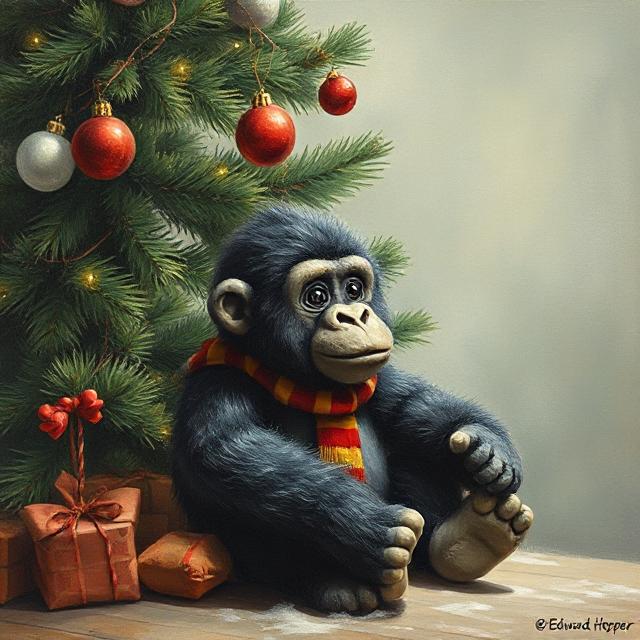
Cuddle Me Coco
The toy was simple: a battery-powered stuffed gorilla that giggled maniacally when pressure was applied to its tummy (when it was hugged). Once every fifth activation, a secondary audio response was triggered—a high-pitched ‘I go bananas for cuddles,’ which became the toy’s slogan to spearhead its advertising campaign.
Cuddle Me Coco was first produced in the summer of 1997. Its initial release was well-received, but by early November, as the Christmas season began to simmer, its popularity boiled over, elevating to a global fad.
It is an understatement to say the coveted toy was difficult to come by. Toys ‘R’ Us, Target, Walmart, you name it, all the shops were assailed by rabid moms and dads, or opportunists wishing to make a buck scalping Coco on eBay. Shop clerks were rolling their eyes, answering phones and saying the same few words to the same single question: No, I’m afraid Cuddle Me Coco is not in stock. Or, to the follow-up query: No, I’m unsure when we will get more. Or, when things got heated: No, I will not shove the telephone up my ass.
As Christmas loomed, mothers and fathers began to sweat. Fake Santas in malls all over the world smiled, ho-ho-hoed and tugged on their immaculate nylon beards, assuring children on their laps that they would, of course, receive their Cuddle Me Coco, provided they were good little boys and girls. There would be absolutely no coal in any stockings that year. Kids would not risk bad behavior, gambling with their chances to obtain a Cuddle Me Coco. Boys abstained from force-feeding boogers to their shrimpy little brothers. Girls no longer scribbled SLUT with lipstick and Crayola in their older sisters’ textbooks.
At the northern apex of the world, Santa was pleased, and in every conceivable nation below its single point, the stock value of coal went south.
The retail value for Cuddle Me Coco was $28.99, but scarcity spiked its value in the eyes and hearts of would-be buyers. Scalpers got wise to this, re-selling them for upwards of $1,500. In one extreme instance, a man from Denver allegedly spent $7,100 to acquire the hot item. In Indiana, a man traded his Ford Escort for a single doll.
On Black Friday, November 28th 1997, crowds amassed in the hundreds —in some cases thousands— gathering in frenzies at the doors of various retail outlets prior to their anticipated moment of opening. In New Brunswick, Canada, three employees and seven shoppers were trampled to death in a Walmart. The Cuddle Me Coco’s were stripped off their shelves in seconds, and sold out ten minutes after the doors had been unlocked. Pools of blood lined the toy aisle. Screams filled the cavernous warehouse building. The intercom sounded: Clean up on aisle five.
Delivery trucks arriving at toy stores were followed, ambushed by marauders who needed their fix. Guns and knives were employed. ‘Give us the gorilla or I’ll paint the sidewalk with your brains.’
A family in an affluent neighborhood outside of Chicago was murdered in their home on Christmas eve. Beyond the broken pane of glass, the crowbarred door for their entry, the home invaders did not touch a single item. They took five lives and a single wrapped package. The jewelry, appliances, and furniture were left untouched, unmolested. The Cuddle Me Coco had disappeared.
Europe was not immune to the Coco Craze, as robberies in France headlined the news in December of ‘97. And that’s not all—Arson in Munich; terrorism in London; stampedes in Pamplona (not from the running of the bulls), all of these events on account of Cuddle Me Coco, which had become so popular that it fringed on religion.
A train derailed in India, causing dozens to perish, and the Cuddle Me Coco on board had been singed. Its total resale value was compromised, yet its worth remained greater than the value of human life (if news coverage is any indication). In Durban, South Africa, a vervet monkey took a Cuddle Me Coco from the terrace of an urban home, which led to a frenzy on the streets below—sixteen dead, many more injured, and untold monkeys mutilated. Most tragic of all: one Cuddle Me Coco was disemboweled of its fluff.
‘Coco-Mania’ slowed down after the new year, fading to a virtual standstill by April 1998. Nonetheless, no one was soon to forget how a simple toy took the world by storm. ‘Coco-Mania’ made its mark in a big way, claiming 716 lives worldwide, and causing untold injury (physical, emotional, spiritual), even ending marriages, certainly reputations. Dignity fell to its knees when confronted with the might of a fad.
Cuddle Me Coco generated an astounding $450 million in sales for ToyStuff, the company behind the craze. This was miles ahead of their usual $40 million in annual sales.
For six months, Cuddle Me Coco was all the rage, reminding mankind that humans are, in fact, great apes, removed from their jungle-dwelling ancestors by a mere 2 percent. For six months, a reflection of humanity glistened in the marble eyes of a stuffed gorilla, showing the masses the ugly truth of themselves, how when peeling back their paper-thin societal reservations, they all go bananas for cuddles.

ABOUT THE ARTIST

James Callan is the author of the novels Anthophile (Alien Buddha Press, 2024) and A Transcendental Habit (Queer Space, 2023). His fiction has appeared in Apocalypse Confidential, BULL, X-R-A-Y, A Thin Slice of Anxiety, Mystery Tribune, and elsewhere. He lives on the Kāpiti Coast, Aotearoa New Zealand.
YOU MAY ALSO LIKE…

WE ASKED 4 LOCAL K-12 TEACHERS FOR THE BASIC INGREDIENTS OF MEXICAN CHICKEN LIME SOUP. HERE ARE THEIR ANSWERS
We interviewed 4 local K-12 school teachers about the basic ingredients of the popular midweek…

I met yr god and 1 more by John Yohe

Godspeed, Kenny Chesney by Torrey Kurtzner

I went to the state of limerence and all I got was this lousy shirt by Andrea Salvador

PHOR!!! 10 GORKO-APPROVED APHORISMS FOR THE AGES

The People vs Ricky Bernstein’s Playboy by Patrick Carella
Image: Flowers of Fealty: Wilhelm Dilich’s Commemoration of the Christening of Elisabeth of Hesse (1598)
Leave a Reply