Not This Time
by Hugh Blanton
In David Duchovny’s debut poetry collection he establishes his bona fides at the outset, telling us he studied under Harold Bloom at Yale and that he’s been writing poetry ever since he was a small child. (He doesn’t tell us why he waited until age sixty-five to publish his poetry, though.) The introduction is both self deprecating and self aggrandizing at the same time and he wrings his hands endlessly over telling us what a poem is. He drops several poets’ names here, all with their definitions of a poem, and takes a shot at Billy Collins by calling him banal (something a lot of poets do to make themselves appear sophisticated).
While Duchovny boasts of studying under Harold Bloom, Harold Bloom would undoubtedly shake his head in disgust to see that his student has misattributed a GK Chesteron quote to Nietzsche: ‘Angels can fly because they take themselves so lightly.’ (Duchovny also got the quote wrong, it’s ‘Angels can fly because they take themselves lightly; devils fall because of their gravity.’) Duchovny says that the first book of poetry he fell for was John Berryman’s 77 Dream Songs, but you’d never guess it by reading the poems in About Time, there doesn’t appear to be a lick of Berryman’s influence in them. Duchovny’s poem of himself and his daughter coming upon roadkill:
But it is only now, as we kneel,
that I notice the vibrant cha-cha line of ants
dancing in and out of the ruined creature
in all their anarchic discipline,
carrying to and fro unseeable bits of meat
and nutrient mouse ooze.
Modernist Berryman would no doubt hoot at the ‘carrying to and fro,’ as the ‘unseeable’ meat would of course only be moving either to or fro, not both.
Duchovny’s use of metaphor and simile ranges from child-like to childish: ‘I swallowed the air like broken glass’, ‘I age like a tree’, ‘as empty as a slice of blue sky in the uncanny valley’, ‘lounging like a roman à clef’. There’s a lot of comparisons with ‘I’, and in fact of the thirty-nine poems in this collection, five of them begin with ‘I’. He also uses emoticons—smiley, sad, wink, and shocked—probably not aware that emoticons went out years ago and now emojis are in. There are plague poems included as well where he refers to coronavirus as ‘Rona, which of course is about as hip as emoticons. His Amanda Gorman-esque rhymes are downright embarrassing:
Now is the silent spring of our discontent,
what is said seduces what is meant.
The breath of life is lethal –
we have nothing to fear but fear itself,
oh yeah and other people:
I’ve got a lot to say and nothing to do,
there’s a gun in my mouth, but it’s pointed at you.
It gets even worse when he tries a rhyme about the six-foot social distancing during COVID: ‘The wicked witch has cast her hex: ‘Six shall take the place of sex.” (In yet another poem he rhymes ‘poisoned chalice’ with ‘über alles‘.) Duchovny’s poems are all surface, and about as vacuous as Gorman’s as well.
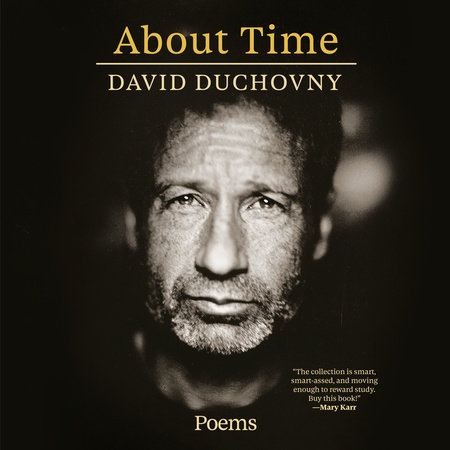
Duchovny authored five works of fiction before trying his hand at poetry (and yes, he wrote about COVID in those as well). Of course everyone is familiar with his acting role as agent Mulder in X Files, but he’s also a musician who’s released three studio albums, he adapted his book Bucky F*cking Dent into a film, and then to top it all off he’s a podcaster too. The cover photo on About Time shows an aged and grizzled Duchovny with a week’s growth of beard, but the haggard look isn’t from overwork, it’s his ‘tortured poet’ look. Like a lot of poets he makes heavy weather of his relationship with his parents and it’s easy to imagine, if he continues writing/publishing poetry, he’ll join Ocean Vuong and Nick Flynn in the Mama Drama/Daddy Drama genre. (The back jacket author photo shows Duchovny at his Hollywood handsome best; shaven face and full head of thick hair.)
The problem with this collection of poetry is Duchovny’s celebrity status. He has never put in the time of sending poems in to editor’s slush piles and receiving streams of rejections in return. Without those vital rejections he hasn’t practiced at his writing, has never asked himself what is wrong with these poems, has never had incentive to get better. Perhaps Duchovny is unaware of cliché, or maybe he just can’t avoid it, but there are two poems here about the hole in his heart, and then he goes on to write a poem titled ‘Cliché Juice’ ironically mocking cliché. It’s been a couple of years now since editors began angrily rejecting plague poems from poets who believe COVID to be a fount of creativity and new themes, Duchovny apparently believes it’s still the avant garde (if it ever was). The poems in About Time read exactly as they are—written by someone, who, after acting, singing, and podcasting, looked around and asked, ‘What else is there to do? Hey, what about poetry?!’
About Time
by David Duchovny, 88 pages
Akashic Books, $19.95
THE END
About the critic

Hugh Blanton‘s latest book is Kentucky Outlaw. He can be reached on X @HughBlanton5.
YOU MAY ALSO LIKE…

Last Day at the Juice-O-Rama by Alyssa Blankenship

You Can Take Away These Five Monuments to Deer Point’s Greatness When You Can Pry Them From Our Cold Dead Hands by Nathan Ellis

It Was Called ‘SmokeNet’ by Mohammad Asgari

Cartoon No. 1

Faux Chairs by Ken Long

Leave a Reply