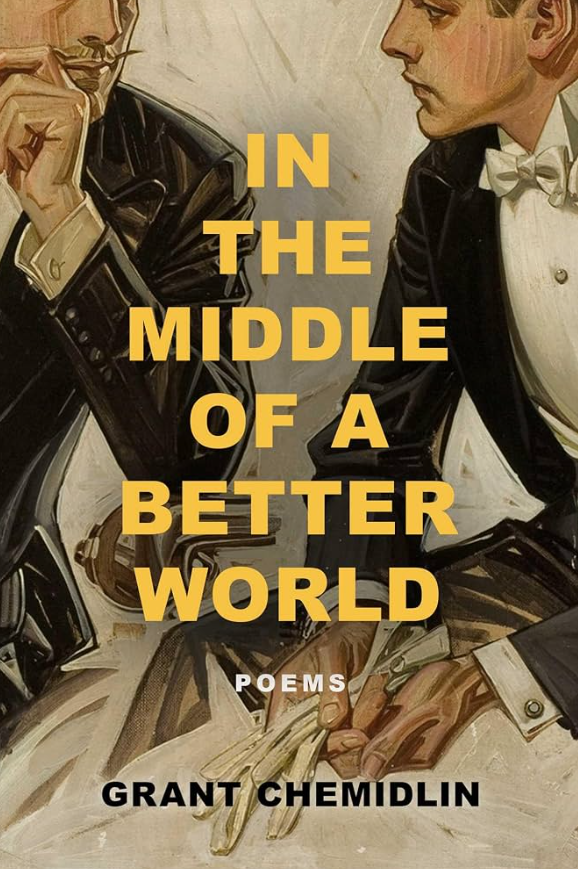
‘OUT IN L.A.’: ON GRANT CHEMIDLIN’S IN THE MIDDLE OF A BETTER WORLD
Reviewed by Hugh Blanton
Grant Chemidlin’s third collection of poetry continues with the theme of sexuality from his preceding books, but despite the singular theme in In the Middle of a Better World it’s still a grab bag of poems. There’s no overall arc to this latest collection, he bounces from subject to subject as easily as changing shoes—from straight people fawning over their gay friends to his own avoidance of his neighbors. He brings in an odd style of erasure poem where the letters f, a, and g have been erased, the lines meticulously planned so that they are erased in sequence: ‘ irst we le rn silence is olden.’ although the surprise becomes irritating, almost like an ambush, where they pop up unsequenced. Chemidlin is a confessional poet, sometimes embarrassingly so, as if he’s the gay male version of Sharon Olds.
Chemidlin’s metaphor balances on tiptoe and uncoils like a rope. An imaginary questioner asks him, ‘Did you always know?’:
Here’s a metaphor:
Someone skips a stone
across a lake. The stone skips on and on.
The stone is gay. The water of the lake is
truth.
The surface of many of the poems here show timidity, but beneath the surface there is a stamina that is both playful and fidgety: ‘Call it wrong,/ but you know you’d be screaming right// if you had my eyes/ at your hips.’ (He also boasts of being able to suppress his gag reflex in the same poem.) Some poets are all surface, some have depths that are bottomless, Chemidlin is somewhere in between—but closer to the shallows.
Chemidlin’s sexuality is the cocoon in which the poems have wrapped themselves, a cocoon that he’s inherited from Beat poet Harold Norse. Norse once said, ‘Gayness is everywhere—which is just another way of saying the erotic is pervasive. It rules much of our lives.’ Federico Garcia Lorca was an influence on both Norse and Chemidlin, Chemidlin borrowed a line of Lorca’s for this collection: ‘A thousand butterfly skeletons sleep within my walls.’ Lorca was murdered during the Spanish Civil War by Franco’s henchmen, Norse wrote a poem about it from the perspective of the gunman: ‘We left him in a ditch// I fired two bullets into his ass/ for being queer.’ Chemidlin would do good to adopt Norse’s aggressiveness.
Chemidlin’s poems serve as a portal for self-discovery, he began writing poetry at the urging of his therapist. After studying Video Production at Villanova, he packed up and headed to Los Angeles to study scriptwriting at The Writing Pad. That’s when he finally came out, age twenty-five, and wrote his first poem: ‘I remember writing it and feeling like it was this magical experience. Instant satisfaction. Something just clicked in me. And from there it snowballed.’ He self published his first collection of poetry He Felt Unwell (So He Wrote This) in 2019 which was later picked up by the publisher Central Avenue Poetry (who still publishes him today). Chemidlin says he looks back on those early poems with ‘a fond embarrassment.’ His second collection, What We Lost in the Swamp, was a finalist for the 2023 Lambda Literary Award for Gay Poetry. Chemidlin now teaches poetry at Pocket MFA and the Poetry Society of New York. He and his poetry are moving ahead at a breakneck pace; if there’s any burnout it isn’t showing up in this latest book.
Like many gay men, Chemidlin looks back on his closeted days with guilt:
For most of my life I was a liar, yes,
because I had to be, but I,
for most of my life was still
a liar, lied even
to myself. For a while, I hated me.
He recalls coming out to his parents: ‘When I said the words ‘I’m Gay,’ my father/ shut like an oyster. My mother was sunny, then/ pouring, ironically already wearing/ her raincoat.’ Still, he desires more courage, imagining even the mice in the walls pitying (but rooting for!) him: ‘Even he/ (the fear driven mouse) feels sorry for you,/ goes to sleep each night praying that tomorrow/ brings you courage.’ This self-effacing strain makes him sound a little like David Sedaris. When Chemidlin writes of his first time, or of cruising in the hidden gay spots of the forest near his home, he doesn’t hurl any romantic gush about.
He’s prompted to write a poem when he finds out a former lover is getting married to a woman:
He’s marrying a woman.
he who slipped down
his swim trunks in the pool
wanted me to see the beautiful
serpent, wanted me
to risk my breath
beneath the surface.
This is about as racy as he gets, even his poems about leather bars are fairly chaste. (‘I say, I’m gay but not/ that gay.’ is from his poem titled ‘Leather Bars’.) Chemidlin doesn’t resort to vulgarity like so many poets do when writing about sex and sexuality. Simple profanity gets the point across just as well, if not better. This poem of the former lover, however, becomes honeyed with regret: ‘I only came to life/ around him, stringless/ puppet.’
Chemidlin’s at his best when he’s using imagism, unfortunately he doesn’t resort to it very much. ‘he reached up & plucked a small fluff/ of cloud from the sky, then popped it/ in his mouth like cotton candy.’ A poet writing this lively and well shouldn’t allow himself to become landlocked as just another ‘gay’ poet; if he expanded his scope and themes it wouldn’t be too much of a stretch to think he could become this century’s Ginsberg, Burroughs, or Kerouac. And considering the late start that Chemidlin’s getting in poetry it could reasonably be expected that his strongest poems are still in front of him.
In the Middle of a Better World
by Grant Chemidlin, 112 pages
Central Avenue Poetry, $18.00
THE END
About the critic

Hugh Blanton‘s latest book is Kentucky Outlaw. He can be reached on X @HughBlanton5.
YOU MAY ALSO LIKE…

I met yr god and 1 more by John Yohe

Godspeed, Kenny Chesney by Torrey Kurtzner

I went to the state of limerence and all I got was this lousy shirt by Andrea Salvador

PHOR!!! 10 GORKO-APPROVED APHORISMS FOR THE AGES

The People vs Ricky Bernstein’s Playboy by Patrick Carella

Leave a Reply