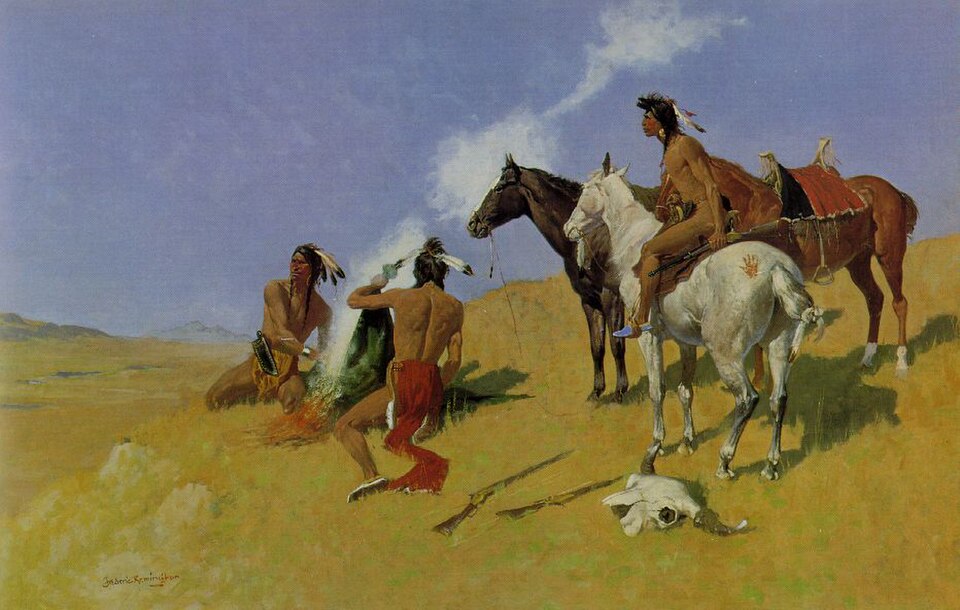
Scientists Discover Native Americans Had Social Media Thousands of Years Before Facebook — It Was Called ‘SmokeNet’
A Special Report from the International Institute for Ancient Media Studies (IIASMS)
WASHINGTON—A groundbreaking study released Monday by the International Institute for Ancient Media Studies (IIASMS) has revealed that Native American communities developed a sophisticated social network using smoke signals thousands of years before the advent of the internet—one that rivals modern platforms like Facebook and Twitter in complexity.
‘We have found conclusive evidence that Native Americans did not merely use smoke for simple messaging, but had constructed an entire ecosystem of social interaction through smoke,’ said Dr. Martha Calder, lead researcher on the project, at a press conference. ‘They posted updates, they liked, they commented, they reposted, and they even had a verification system. Yes, they had a fully functional smoke-based social network, which we have named ‘SmokeNet.’‘
According to researchers, SmokeNet operated through a complex code of smoke patterns—short and long puffs, thick and thin plumes, and even colored smoke to convey different emotions.
‘We discovered a pictograph showing a Native American sending a love message to his wife through heart-shaped smoke,’ Calder said, pointing to a slide of an ancient drawing. ‘And then, in response, a puff of smoke in the shape of heart-eyes appeared from the other direction. That was their version of a ‘like.’‘
Researchers also uncovered evidence of a verification system. ‘Verified accounts were identified by having a fellow tribe member confirm that the user was, in fact, who they claimed to be,’ Calder explained. ‘Interestingly, there was no blue checkmark, because, according to our researchers, producing blue smoke was extremely difficult.’
One of the most intriguing discoveries was a primitive recommendation algorithm. ‘Users who frequently sent smoke about hunting were subsequently shown more hunting-related smoke,’ Calder said. ‘Meanwhile, those who expressed interest in tribal politics eventually saw nothing but endless arguments between their uncles.’
Further evidence of targeted advertising was also uncovered. Users who frequently sent hunting smoke were later exposed to promotional smoke for better spears. ‘One particularly aggressive advertiser sent the same message forty-seven times,’ Calder noted. ‘We believe this is the first documented case of spam in human history.’
The research team also found evidence of content moderation. ‘Users who sent excessive smoke were temporarily silenced,’ Calder said. ‘We found a stone tablet that read: ‘You have been muted for 24 hours due to excessive smoke-signaling.’‘
Among the more colorful findings were traces of ‘smoke influencers.’ A user named ‘Red Fox,’ who appears to have been a prominent figure, posted what seemed to be a promotional message: ‘Using this smoke will make your skin soft and smooth. Just puff ten times and then… wait, this is for hunting. My mistake.’ The post drew multiple responses, including: ‘Being an influencer isn’t for everyone,’ and, ‘I liked this post, but I’m not sure why.’
Researchers also documented early internet-style arguments. A user named ‘Lone Wolf’ posted: ‘I believe I am the best hunter in our tribe. The rest are followers.’ This was met with swift backlash. A user called ‘Angry Buffalo’ replied, ‘You couldn’t catch a rabbit if it walked into your tent.’ Another user, ‘Rattlesnake,’ wrote, ‘I am reporting this post. It contains offensive content.’ Lone Wolf responded, ‘Five likes.’ Rattlesnake fired back, ‘I got twenty. Go do something else.’
Calder also noted evidence of a notification system. ‘Users would receive three short puffs from the nearest hill whenever they received a like or a comment,’ she said. ‘However, it is unclear whether they had the ability to turn off these notifications. One inscription we found read: ‘Please stop sending me smoke signals. I am trying to sleep.’‘
In one of the more sobering findings, the team discovered what appears to be the last post ever made on SmokeNet. Sent by a user named ‘Last Survivor,’ it read: ‘Hello friends. I think this is my final post. A large ship is approaching from across the water. I believe they may have a social network as well—but they seem to use strange things like ‘electricity’ and ‘wires.’ Goodbye.’ No comments were ever recorded beneath the post, Calder noted, ‘because there was no one left to reply.’
Calder concluded the press conference with a final thought: ‘If Columbus had arrived just one day later, he might have seen a smoke signal that read: ‘This land was ours. Now it is yours. Like if you agree.’ And Columbus, in turn, would likely have responded with three short puffs.’
THE END

ABOUT THE ARTIST
Mohammad Asgari is not a professional writer, but he writes from time to time. He lives in Iran and writes his pieces in Persian, which are then translated into English with the help of a translator.
YOU MAY ALSO LIKE…

Chicken by Joe Couture

3 poems by Stephen Bales

Daylight Robbery and 1 more by Lynn White

Dreadlocks by Arthur Neong

YOU KNOW I LIKE MY GIRLS A LITTLE BIT OLDER


Leave a Reply