Unnecessary Fiction
by Hugh Blanton
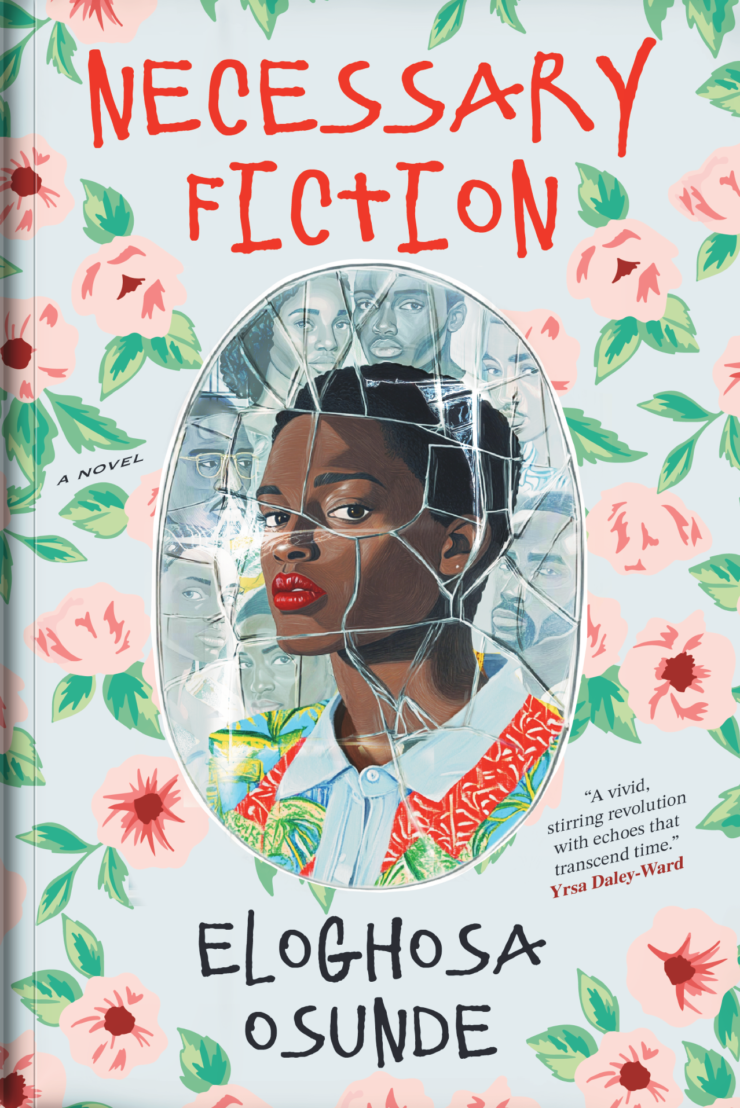
Eloghosa Osunde’s latest novel Necessary Fiction opens up with an unnamed narrator giving us a list of his personality characteristics he wants us to know about himself. First, he’s a hustler through and through. Second, he knows how to make all the crucial handshakes. On and on he goes, confident that his self-importance will also be important to you the reader. This opening chapter first appeared as a short story in the Fall 2020 edition of The Paris Review (and won the Plimpton Prize). We know the unnamed narrator is Ziz only because Osunde tells us so in subsequent interviews about the short story and the book. Necessary Fiction includes a dramatis personae (Ziz at the top, so maybe it wouldn’t be unreasonable to assume Ziz is our unnamed narrator), probably there to help the reader keep track of the enormous number of characters in the book. And while there are more than twenty-five names listed, it’s only a fraction of the actual number of characters in the book—and yes, the reader will be forced to go through the backstory of nearly every last one of them.
Necessary Fiction is centered in Lagos, Nigeria, just like their first novel Vagabonds!. (No, Necessary Fiction is not authored by multiple authors, Osunde offers up their pronouns as they/them—identity politics pays no heed to singular/plural grammar rules.) The prose is as flat as the Serengeti (after the opening chapter, anyway) and the numerous characters wail over wanting to be loved, included, and cherished as young immature people are wont to do. Osunde includes difficult and impossible to decipher Pidgin, ‘because secret yato si secret, kink yato si kink,’ ‘Wetin dey there to dey sad about?’ ‘As for me oh; wetin dey pain me na money.’ (maybe this is waiting they pay me the money?), ‘But I don realize smallsmall say e really get why o.’ The characters move randomly between Pidgin and plain English, the Pidgin kept to a minimum to keep from confusing the reader (though it does get ridiculous when one character moves between Pidgin and plain in a text message). Necessary Fiction is a found-family novel, the young queer characters have bonded together in Lagos—some of them contemplating moving to less repressive countries where they can be themselves without fear of retribution and ridicule.
We come up on what we think is a new character named Six, just to find out a few paragraphs later her name is Seven. And then Eight, and so on. This is Osunde’s passive and unengaging way to show character aging and the passing of time. (The character’s name was Awele.) It gets confusing when we see age being used for a character name again later and find out that it’s not Awele, but a different character this time. This time it’s Yemisi (a former lover of Awele), and at ‘Nineteen,’ like a good Gen-Z’er, she starts using Adderall. She says she needs it to help her study after returning to Lagos from attending college in the USA. She realizes she prefers the USA to Nigeria: ‘Saner structures, stable electricity, less judgment, distance and travel, lovely seasons like fall, no child beggars in traffic clawing at glistening cars, people living colorful vibrant lives even when they have little, museums, parks, cappucinos [sic], dancing freely in seedy bars, the promise of a grand life whipping the air.’ (There’s actually a term for this in Nigeria—Japa Wave—young people leaving Nigeria for better prospects abroad.)
The characters in Necessary Fiction are living lives of leisure, they are always sitting around talking about their feelings, their mama drama, their daddy drama. You wonder how they pay their bills or how they could be so miserable when they’ve never had to deal with things like overdrawn bank accounts, car breakdowns, being late for work, a backed up toilet. Awele, who was sent to the UK by her mother after she was outed as a lesbian at school, thinks her mother is homophobic. However, her mother, Isoken, is actually carrying on a secret affair with a woman herself. Isoken tells her therapist what hurts her about Awele now that her daughter is comfortably out of the closet: ‘The small mindedness of it all. In my days, people didn’t just get up one day and tell strangers who they really loved. It’s not necessary. And it’s just not done. I’m not telling her who to love, I’m telling her to reconsider what information she arms strangers with.’ Isoken finishes up: ‘They think they are braver; they are just louder.’
During one of their Truth Circles (the name they had given to sitting around talking about themselves), Leke makes a vague mention about an event that traumatized him: ‘I look like I’m fine, but me, I still haven’t recovered from what the soldiers did at toll gate that October 2020. I know that many other things have happened since then, but that whole time fucked me up in a way I can’t reverse.’ Leke doesn’t go into any more detail about what happened. In October of 2020 there were mass protests across Nigeria calling for the disbandment of the police Special Anti-Robbery Squad, a squad notorious for its brutality. A protest erupted at the Lekki toll gate in Lagos and the Nigerian army opened fire on the protesters. The next day Lagos State governor Babajide Sanwo-olu announced that no protesters had been killed, but later in a CNN interview said that two had been killed. Amnesty International estimates there were twelve killed. The SARS was disbanded, but there was no mention of discipline against the crooked cops that ran it. They were undoubtedly just reassigned to other divisions of the police force.
It isn’t the bland prose that keeps the characters on the page from coming to life, it’s their total solipsism and superficiality. They make heavy weather of their yearning for love, but it’s the same yearning all young people their age have. Necessary Fiction is rife with shallow philosophizing: ‘Did life always make sense? No. Did love always feel painless? No.’ ‘Safety softens the mind’s shadow, shows the heart what else is there.’ Osunde strives for moments of epiphany that simply never arrive.
Necessary Fiction
by Eloghosa Osunde, 302 pages
Riverhead Books, $28.00
THE END
About the critic

Hugh Blanton‘s latest book is Kentucky Outlaw. He can be reached on X @HughBlanton5.
‘Call Us What We Bloviate’ originally published on Terror House in August 2022.
YOU MAY ALSO LIKE…

‘CAN YOU SPOT THE TEN DIFFERENCES BETWEEN THESE TWO IMAGES?’ by Ron Arbuckle

Cartoons by Dmitriy Kogan

THERE ARE MORE THAN 50 NEW FEARS REGISTERED EVERY SINGLE HOUR ON PHOBIAPEDIA. HERE ARE THE TOP 6 FEARS MOST LIKELY TO COME TRUE IN YOUR LIFETIME

Emily Dickinson Blues by J.R. Solonche

MITCH’S LET’S JUMP THE TOP GUN! TOP TEN MOVIES OF 2026 IN JULY

Leave a Reply