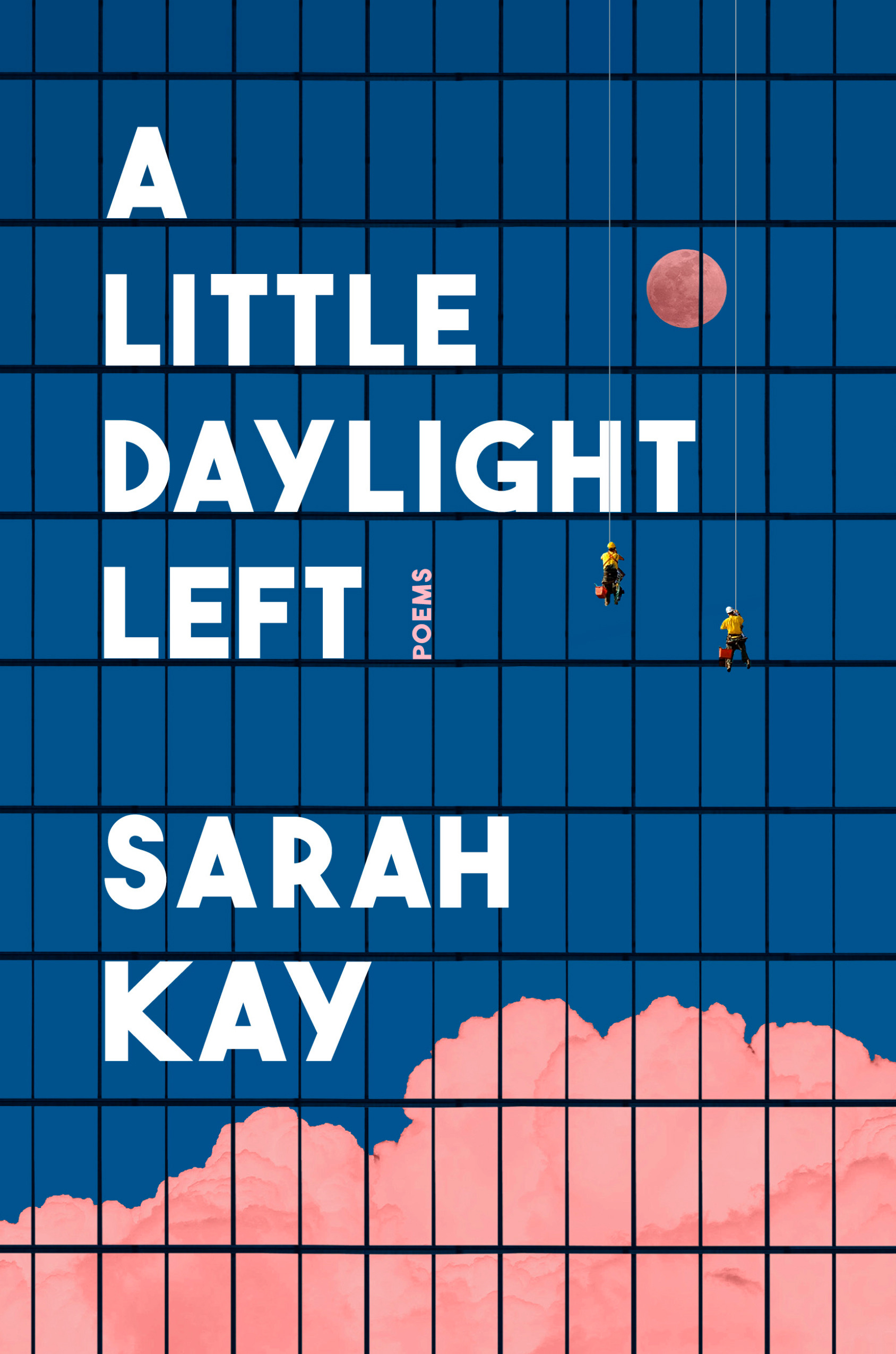
The Performing Poet: On Sarah Kay’s A Little Daylight Left
by Hugh Blanton
Sarah Kay’s newest book of poetry still has the youthful exuberance she’s had since her spoken-poetry teen years. She was anonymously entered into a poetry slam contest when she was fourteen years old in 2012 (to this day she doesn’t know who entered her) at the Bowery Poetry Club in New York City and she’s been hooked on performative poetry ever since. A Little Daylight Left is a mad dash through human relationships—Kay’s world revolves around her friends, family, and lovers. The poems here are bereft of complexity but rich in metaphor, caroming from topic to topic like a bumper car in a carnival. Plenty of poets today use the ‘&’ in place of ‘and’ as a gimmick, Kay uses it to keep from slowing down her frenetic energy (the word ‘and’ does not appear anywhere in A Little Daylight Left, not even in the notes and acknowledgments).
Despite the breezy tone throughout much of the collection, Kay has a morbid fascination with terrorist attacks. She was living in New York City in September of 2001 when the twin towers were struck, and she was living in Jakarta in January of 2016 when the Sarinah mall was attacked by terrorists. She writes of both events here, and she also includes a poem on the 2016 Bastille Day attack on the French Riviera, where she was desperately texting a friend who lived in Paris at the time to see if she was okay. These aren’t the only times the poems veer into seriousness, she dons her sage’s hat in her poem ‘Knowing’ where she begins: ‘You list the Things You Know to Be True on Monday/ & by Thursday half of them have gone overripe on the vine.’ Toward the end she issues commands:
I am not saying let Certainty be your only god.
I have seen the haircuts he demands in his honor.
I am saying if you know, when you know,
you have to honor it. You have to follow it.
Being a sage seems to require vagueness, fortunately she doesn’t stay in this lane very long.
Kay is a wildly popular spoken word poet. Her videos on YouTube (including a TedTalk video) have millions of views, and there are long lines to see her at venues where she recites live. She keeps her poems simple and accessible even while making ample use of metaphor. In a March 2018 interview in Elle magazine she said, ‘For so many people, poetry is given to them as a riddle they have to solve, and if they don’t solve it, they think, ‘I’m too stupid to understand poetry,’ or ‘poetry isn’t for me.’‘ Kay has said she wants her poems to invite people into a story, not to be an exclusionary weapon that makes people feel unworthy of poetry. (The Instagram poets practice this philosophy, too, but it mostly just comes off as vacuous guff.) You could say Kay is an anti-modernist. That’s not to say that she can not be bewildering—her poem ‘Across the Room’ jumps between reality and fantasy but it’s not until you reach the end of the poem that you realize it, and even then only after giving it another read-through.
Kay has been writing poetry consistently since she was fourteen years old, but being mostly a spoken-word poet, A Little Daylight Left is only her second full-length collection (she’s thirty-six). She writes some poems for the stage, other poems for the page, and with the way she experiments with form here you can see that many of these poems were for the page only. Her page poems are getting her recognition as well as her spoken performances—she was recognized by a group of Buddhist priests in the Dallas/Fort Worth airport who gave her a poem of their own in gratitude of her work. The poem they gave her was written in Sanskrit and Kay includes it in the notes section in the back of this book. However, she makes it plain that she her heart lies mostly on the stage when she mentions in her poem ‘Unreliable’: ‘I thought I wanted a boyfriend but I actually wanted an audience.’ There’s rarely any artiness of affectation in any of Kay’s poems, and her vulnerability asks for no pity. She reminds one of Billy Collins when she reaches back in her childhood memories to describe an animal she had seen behind her uncle’s rural cabin: ‘It could just as easily be a cat/ who has not gotten enough sleep lately,/ or a cat who got popped one in the nose/ & earned himself two shiners.’ (A raccoon, of course.)
Kay says she writes poems when there’s something she can not navigate without poetry. In trying to navigate romantic relationships she likens them to a church. In her poem ‘The Church of Coupledom’: ‘her evangelists so savvy,/ even at your most chimerical,/ before you can even read,/ they have made a disciple out of you.’ Then of course there is always the aftermath of the inevitable breakups:
& there you go again,
embarrassingly knocking on the wooden doors,
fumbling your meager alms to see
if there is still time for your salvation,
still time to join the sanctified
in the holy land of partnership
It’s easy to imagine the embarrassed laughs that stanza would get at a poetry slam.
The thread of humor runs throughout A Little Daylight Left, Kay often laughs at her own tragedies. Most poets of course use tragedy for outrage, but outrage only takes poetry so far. Kay writes of her car being broken into and the thief stealing, among other things, her vibrator. Left behind, however, were her poetry books that had been boxed up in the back seat. The thief tossed them aside before deciding to leave without them. (He must have been a modernist.) Kay’s poem ‘Tsubu,’ about the single grain of rice stuck on an overeager eater’s cheek, is a poem shorn of commas and periods so that it sprints along until it collapses from exhaustion (even though the message isn’t urgent enough for sprinting). Kay makes adept use of metaphor to keep her humorous poems funny (something a lot of poets try and fail at), but she sometimes tires of metaphor: ‘& I do not want these metaphors./ I would give them all back if I could.// Even if it meant a rainstorm would forever be just a rainstorm,/ a ladybug on my arm simply that.’ Even her anti-metaphors are metaphorical.
A Little Daylight Left
by Sarah Kay, 94 pages
The Dial Press, $24.00
THE END
About the critic

Hugh Blanton‘s latest book is Kentucky Outlaw. He can be reached on X @HughBlanton5.
YOU MAY ALSO LIKE…

Cartoons by Dmitriy Kogan

THERE ARE MORE THAN 50 NEW FEARS REGISTERED EVERY SINGLE HOUR ON PHOBIAPEDIA. HERE ARE THE TOP 6 FEARS MOST LIKELY TO COME TRUE IN YOUR LIFETIME

Emily Dickinson Blues by J.R. Solonche

MITCH’S LET’S JUMP THE TOP GUN! TOP TEN MOVIES OF 2026 IN JULY

In Water by Jack B. Bedell

Leave a Reply